Of sweet and sour and the keys to their battle..

narthangai pickle

I like lemons. Only when they are doused in sugar. Which means very sweet lime juice, sweet lemon pickle, lemon sponge, lemon curd, lemon meringue… well you get the gist – the sour stuff is palatable only when it’s paired with it’s counterpart – lots of the counterpart, in fact!

I’ve had people asking me why the rasam and sambar taste a little sweet in my home. That’s because of the Kannadiga genes from my father’s side (Kannadigas are the best vegetarian cooks in the world, btw, and if you want to dispute THAT, you’ll have to do it down below – in the comments section! 😉 ) – genes which entail a built-in sense of balance – of sweet and sour, chili and salty and an overall sense of tastiness. Something that has been endorsed by science – don’t believe me? check this Washington Post article which is all over the internet today – predictably! Here’s the link : http://www.washingtonpost.com/blogs/wonkblog/wp/2015/03/03/a-scientific-explanation-of-what-makes-indian-food-so-delicious/

All this learning and awareness of regional differences in cuisines came over the decades but when I was a very young bride, having decided to marry a Palghat Iyer, I was in for a shock – mostly in terms of cuisine! The sambar knocked my teeth back with its sourness, the rasam brought tears to my eyes with the kharam (chili heat) and I’m not even going to talk about things like pulikacchal and vatha kozhambu – couldn’t get them beyond my incisors!

It took me a while but I learnt to even like many of these dishes though the ultra sour stuff like puli inji (slices of ginger cooked in tamarind – very hot and very sour!) still take some working up of courage! Hubby, like a true Iyer, did NOT relish the sweetish element that I introduced into the sambars and rasams and we’ve had many a fight with me flinging the lump of jaggery at him when he objected to my putting it in the sambar!

On one memorable occasion, I flung it at him but unfortunately, forgot that I had put the jaggery down and picked up a bunch of keys and threw the keys at him. Well, not being very gifted at sports (holding the distinction of being always the last person to picked on the throwball team throughout high school!) and husband being consummately gifted at sports, my throw went awry and he ducked and the keys hit the chandelier which came crashing down! End result was much laughter and a bill from the landlady – which we really scraped the bottom of the barrel to pay!

He’s learnt to get used to and to even relish the jaggery in the sambar and pulikacchal now while I’ve learnt to overlook the puli inji without a shudder – there is a delicate balance!

One dish with which I had no such problem is the beloved-of-all-Palghats-and-maybe-all-other-Iyers-I-wouldn’t-know is the narthangai or citron pickle. Bitter and sour, the dish has absolutely no element of my beloved jaggery and sugar, but I love it! The one thing I do want to eat when my tummy is unwell, guaranteed setter-right of illnesses of various kinds – I won’t guarantee heartache but pretty much everything else!

Last month, traveling in the Himalayas, I came across this tree laden with the most delicious looking citrons – variety called kidarangai – see pic – and begged one off the owner (well, I was going to pinch it but then caught sight of an old man watching me suspiciously so I had to ask!)

Bought a few in the market and brought them all the way back to Chennai to make this pickle. The method for pickling narthangai and kidarangai is the same.

NARTHANGAI/KIDARANGAI/NAARINJA/DABBAKAI/CITRON PICKLED IN BRINE

  • Narthangais or kidarangais– 3 large
  • Salt – 1 tbsp
  • Turmeric – 1 tsp
  • Roasted fenugreek powder – 1 tsp
  • Red chili powder – 2 tsp (OPTIONAL) – if you want a hot pickle
  • Gingelly oil – 2 tbsp

Wash and dry the fruit well. Slice the tops and tails off the citrons.

Slice into thin roundels and each roundel into four quarters. Add the salt and turmeric and mix well.

Cover and set aside. Shake every day for 4-5 days till the pieces are soft and the colour changes. Mix in the roasted fenugreek powder.

Mix the chili powder in if using and stir well. Heat the gingelly oil and add on top. Mix. Bottle in a sterile jar.

Super with curd rice or generally to lick. I love carrying it around for travel sickness too!

And no, I don’t advocate any jaggery in this – try throwing stuff at me – I’ve learnt to duck too!

Of the Darwin awards and their winners!

onion pakoda

A friend sent me a forward this morning listing the Darwin award winners for this year – a list of those whom evolution seems to have left behind… and the winners fall somewhere between a Galapagos turtle and a dodo on the ‘survival instinct’ scale. I hasten to add that no insult is intended to the dodo at all – after all, it existed for millions of years before man set foot on Mauritius! And no dodo could have known that it was being viewed as food by these ‘other’ interesting flightless two-legged birds!

The Darwin award winners, on the contrary, have lived and walked among their own kind all their lives – my vote for intelligence goes to the dodo!

Am not going to give you the whole list here but I cannot resist the winner! Here goes:

“AND THE WINNER IS… ”

Zookeeper Friedrich Riesfeldt (Paderborn , Germany ) fed his constipated elephant 22 doses of animal laxative and more than a bushel of berries, figs and prunes before the plugged-up pachyderm finally got relief.

Investigators say ill-fated Friedrich, 46, was attempting to give the ailing elephant an olive oil enema when the relieved beast unloaded.

The sheer force of the elephant’s unexpected defecation knocked Mr Riesfeldt to the ground where he struck his head on a rock as the elephant continued to evacuate 200 pounds of dung on top of him. It seems to be just one of those freak accidents that proves… ‘*Shit happens*’

* *RIP Mr Riesfeldt **

I got to wondering how come all these awards are given to people only in the US of A – surely the US does not have a monopoly on sub-dodos? And I’m sure enough of them walk the other countries on earth! But then, only the US probably has enough money to do research and dig out these facts! Inviting all my readers here to please send me in your own stories of experiences with the… Darwinians!

Will start with sharing my own… once upon a time, some forty years ago – when I was about ten years old, my parents had a family over to dinner – a rather common occurrence, so why do I remember this family in particular? First they had a little girl – about my age and sharing my own name – except she pronounced it “Onuradha” – my first meeting with someone from the eastern part of India. I had trouble initially figuring out what she was saying – am sure she had equal trouble with understanding my South Indian accent too. So, before dinner, everyone was sitting around in the garden, the older people having a drink – beautiful Hyderabadi winter evening when you felt glad to be alive! The cook brings out several plates of onion pakodas as appetisers. Hot pakodas – steam curling up above the plates…. yum… my new friend grabs a few, goes “Owww…” with the super-hot, fresh from the stove temperature. We all have little plates into which we drop ours waiting for them to cool off. Not Onuradha. She grabs hers, goes over to the garden tap, opens it and proceeds to douse her pakodas in cold water! We’d never seen this before and I am glad to say, never since! And then pops the now-gooey mass of besan and onion into her mouth!

Her parents turn red… we turn to our parents for a cue… obviously dying to laugh… but the famed Hyderabadi tehzeeb (culture), not to mention glares from both parents – effectively zips our mouths… till later in the evening when the guests have gone…

Even my parents permit themselves the ghost of a smile!

Reproducing those pakodas today:

ONION PAKODAS:

  • Large onions – 2  – sliced very fine
  • Besan/gram flour – 1.5 cups
  • Rice flour – 2 tbsp
  • Greeen chilies  minced – 2
  • Ajwain/caraway seeds/omam – 1 tsp – crushed
  • Curry leaves – 3 sprigs – chopped
  • Ginger – 1/2 ” piece – grated
  • Saunf/aniseed – 1/4 tsp – crushed (optional)
  • Salt
  • Red chili powder – 1/2 tsp
  • Chat masala – 1/4 tsp
  • Melted ghee – 1 tsp
  • Oil for deep frying

Mix all the ingredients except the oil. Do not add any water at this stage. Let the onions rest in the batter for about 15 minutes – they will sweat a bit. Mix again and add a little more water if necessary to hold the onions together. Pinch off small lumps and deep fry on medium heat till crisp and golden brown.

Serve hot with ketchup or tamarind sauce.

DO NOT douse in water unless you’re a contender for the Darwins!

Of Laloo and aloo and the MIGHTY samosa which felled him!

irani samosas

Jab tak samose mein aloo rahega,

Tab tak Bihar mein Laloo rahega! 

I’ve always been a bit of a newspaper snob, reading only the Hindu and turning my nose up at all the other papers – and there are SIX of them that get delivered every morning. These last few days, however, convalescing, I finish the Hindu and then, since there’s very little else i can do, find time hanging on my hands a bit. Idly picked up the Times of India – a paper which, from cursory earlier reading, I’ve always thought had not much news worth reading nor much commentary worth reading – I owe a BIG apology to the Times – it has livened up my mornings by telling me sundry happenings in India which include how the administrators of Bareilly want to paint dangerous dogs blue (yes, i know i’ve written a whole story about it but i still can’t get over it!) and today’s item about Laloo Prasad Yadav and the samosa!

I CANNOT, for the life of me, imagine the staid Hindu publishing something like this. I still love it but am realising that the Hindu is my curd rice (perugannam/thayir saadam) to the paneer-butter masala that the Times offers! Can’t do without the former but the latter offers occasional exciting possibilites to the palate!

Lalu, the politician you cannot ignore, even if you try. The man is so newsworthy that he MUST have got voted to power time after time and all the way to the Chief Ministerial gaddi (seat) in Bihar purely on the strength of his ability to make his voters laugh! Sample these:

My mother always told me not to handle a buffalo by its tail, but always catch it by its horns. And I have used that lesson in everything in my life, including the Railways.” And the even more pithy, “If you do not milk the cow fully, it falls sick!” Except that Lalu mistook the state of Bihar and then the Ministry of Railways for members of the bovine species and proceeded to keep them “healthy” by milking them very, very well indeed!

Apocryphal stories abound… NASA was interviewing professionals to be sent to Mars. Only one person could go, and he will not return to Earth.

The first applicant, an American engineer, was asked how much he wanted to be paid for going.

“A million dollars”, he answered. “Because I wish to donate it to M.I.T.” The next applicant, a Russian doctor, was asked the same question. He asked for two million dollars.

“I wish to give a million to my family, he explained. “And leave the other million for the advancement of medical research.”

The last applicant was a Indian politician (Lallu Yadav). When asked how much money he wanted, he whispered in the interviewer’s ear.

“Three million dollars.” “Why so much more than the others?” the interviewer asked.

The Indian politician replied, $1 million is for you, I’ll keep $1million, and we’ll give the American engineer $1million and send him to Mars.” 😉

In Hindu mythology, stories abound of men and women attaining divine powers through the practice of austerities but there’s always a twist in the tale – a Catch 22 loophole which enables god to defeat them when they grow too big for their boots (an almost inevitable consequence of too much power). Like the case of Hiranyakashyapu, for instance who gains a boon that he will be killed neither by man nor beast, neither indoors nor outdoors, neither during the day nor night… he ends up being killed by Narasimha half-man, half animal, at twilight, on the threshold of his palace – all absolutely correct as per the letter of the boon.

But in the case of the samosa, Lalu ji seems to have forgotten about Irani samosasjis mein aloo nahin hain! (there are no potatoes in this variety of samosa)! And I think that’s why he lost the elections and got indicted – all because of the lack of an aloo in a samosa – talk about for want of a nail…

So, Laloo-ji, aapke liye special…

IRANI SAMOSA to make about 12-14

  • 1 cup maida
  • 1/2 ts salt
  • 2 tsp hot oil
  • Water

Knead all this into a smooth dough, cover and set aside.

FOR THE FILLING

  • Onions – 2 – sliced fine
  • Green chili – 1 – minced
  • Red chili powder – 1/2 tsp
  • Dhania/coriander powder – 1/2 tsp
  • Turmeric – 1/2 tsp
  • Asafoetida – 1 pinch
  • Dried dill – 1/2 tsp (sooya in Hindi/soyya koora in Telugu) – this is what gives Irani samosas their distinctive flavour
  • Poha/beaten rice/atukulu – 2 tbsp – roasted and powdered
  • Salt – 1/2 tsp
  • Coriander leaves – chopped – 2 tbsp
  • Lemon juice or amchoor powder – 1/2 tsp
  • Oil – 1 tbsp

OIL FOR DEEP FRYING – 2 cups

FOR SEALING: 2 tbsp maida mixed with 1 tbsp water.

Heat 1 tbsp of oil in a pan and add the onions and green chilies. Fry till onions are golden brown.

Add all the other ingredients and stir till the mixture is reasonably dry.

A too-wet mixture makes the samosas soggy. The poha helps absorb excess liquid. Let it cool.

Make small balls of the dough and roll out into thin pooris – you should be able to see your nails under the poori!

Cut each poori into half. Gather the two radii together and make each half into a cone.

Place a spoonful of filling into the cone and bring the circumference together. Seal the edges using the maida-water slurry.

Deep fry in batches – the oil should be medium hot. Too hot will make the surface erupt in large bubbles and the samosa will not be crisp. Too cool will make the samosas oily.

Remove and drain on paper.

And Laloo-ji – huh… where IS he? Bihar mein tho nahin hain? (He’s disappeared from Bihar) – defeated by the tiny samosa – henceforth to be known as the MIGHTY Samosa!

P.S.: One more trick or kituku – before you start frying the samosas in oil, fry 2-3 flakes of garlic in the oil and remove. The samosas will have an absolutely divine fragrance 🙂

Of how to sell your food and lessons for Philip Kotler!

kofta

“But what is in this? It smells… weird,” says husband of a few months.

“What do you mean, weird?” And suddenly wondering whether I’ve put in peri-peri instead of tomato paste or something equally horrendous, I bend over and smell it. Smells good. Great, in fact. Pick up a spoon and try a little. It tastes even better than it smells.

Turn back to husband. “It’s simply superb. Are you sickening for something, by any chance?” and I solicitously take his temperature. Purrfect 98.4C.

Ask him to try a litle more but he doesn’t. Makes a face, in fact! Humpphh… too bad… I’ve spent much time and effort on creating this kofte ki subzi and I have NO intention of letting it go to waste… nor of making something else! So I feast on pulao and koftas while hubby makes do with a pickle! Am still puzzled about what he found wrong with it because the more of it I polish off, the more I like it!

That too because he’s told me earlier that koftas are one of his favourite “restaurant” foods. My koftas are pretty good – after all, I’ve eaten plenty of them at my friend Priya’s place and if a Kayasth household cannot turn out the best koftas… then… I’m a monkey’s aunt! It’s a different matter that I actually am – aunt ot many monkeys 😉 But we’re not discussing nephews and nieces here, only koftas!

The penny drops a few days later when we sit down to dine at a restaurant and husband dear orders his favourite food. This time, I’m paying attention and hear him tell the waiter, “Malai kofta bina lasan (or lassoong as he likes to pronounce it!).” Malai kofta without garlic!

“But how can they make it without garlic?” I ask.

“You see – they will”, he assures me confidently.

I’m sceptical, but willing to wait and see – after all, this is Madras and maybe they can turn out malai koftas without garlic. I don’t even see why anyone would want to eat them like that!

The waiter reassures my husband – yes, sir, yes sir, three bags full – stuff.

And comes back some twenty minutes later with our order – peas pulao and malai kofta. I get a whiff of the garlic as I serve myself and more than a whiff as I dig into it! Hubby happily tucks into it and polishes off the dish and orders seconds!

“But if you dislike garlic so much, how can you eat this? It’s full of garlic!” I ask.

“Oh, no, didn’t you hear me order and the waiter say yes?” – Hubby…

Well…

Then the penny drops, when I was making koftas earlier, the peeled pods of garlic – some 3-4 of them – were lying on the kitchen counter in plain sight – so he KNEW there was garlic in the curry and therefore all the nakhras! Here, the waiter (whom we’ve never seen in our lives and probably never will again!) assures him that there is no garlic and he buys it!

Philip Kotler’s marketing lessons all begin to make sense! It’s all about how you sell it – the customer will buy anything!

Also that  there is no limit to how much wool the customer is willing to pull over his/her own eyes! On several other occasions, at Chinese restaurants, hubby finishes off the little bowls of sweet chili-garlic sauce and keeps asking for more. The obvious question from the family has to be answered – about garlic. “Oh, no, there is no garlic in this,” he replies quite blithely!

Ah well… it’s always been useful anyway – he’s eaten and enjoyed spaghetti with loads of garlic and been none the wiser for it!

Here’s the low fat kofta that we make today…

VEGETABLE KOFTA WITH NO GARLIC (wink, wink!):

FOR THE KOFTAS

  • Besan/gram flour – 2 tbsp
  • Boiled peas – mashed slightly – 1/4 cu
  • Boiled, grated potatoes- 2 small or 1 large
  • Paneer/cottage cheese – grated – 3 tbsp
  • Kasuti methi – 1 tsp
  • Cumin/jeera powder – 1/2 tsp
  • Red chili powder – 1/4 tsp
  • Amchur/dry mango powder – 1/4 tsp
  • Minced green chilies – 2
  • Breadcrumbs or gulab jamun mix – 2 tbsp
  • Fresh coriander – chopped 2 tbsp
  • Salt
  • Asafoetida – 1 pinch

Mix everything together except the gulab jamun mix (if using). Let it rest for about ten minutes.

Then add the breadcrumbs OR gulab jamun mix and mix together till it just holds together and is reasonably firm and not watery.

Using the paniyaram pan, make small balls of the mixture and fry pouring a few drops of oil into the bottom of each pan.

Cover and cook till the bottom is golden brown. Turn over with a skewer and cook, uncovered till the other side is also done. Set aside the koftas.

FOR THE GRAVY

  • Onions – 2 medium
  • Garlic (keep it quiet!) – 2 flakes
  • Ginger – 1/2″ piece
  • Cashewnuts – 6-7

Grind these together to a fine paste.

  • Tomatoes – 4 large
  • Kasooti methi – 1 tsp
  • Cumin seeds – 1/4 tsp
  • Coriander powder/dhania – 1/2 tsp
  • Minced green chilies – 2
  • Red chili powder – 1/2 tsp
  • Garam masala powder – 1/2 tsp
  • Tej patta/bay leaf – 1
  • Cardamoms – 2
  • Saunf/fennel seeds – optional – 1 large pinch
  • Turmeric  – 1/2 tsp
  • Oil or ghee – 2 tbsp
  • Sugar – 1/2 tsp
  • Salt

Grind together the tomatoes, kasooti methi and cardamoms to a smooth paste.

METHOD

Heat the oil or ghee in a pan and caramelise the sugar in it.

Add cumin seeds, fennel seeds, bay leaf, minced green chilies and stir for a few seconds.

Add the ground onion paste and fry till the raw smell of onion is gone. Add the tomato paste and the powders and cook for about ten to twelve minutes till the gravy is smelling quite irresistable!

Add the koftas and simmer for a few minutes more.

Switch off and garnish with cream and coriander if you’re feeling thin and a ladleful of milk if you’re feeling un-thin! Serve with plain white basmati rice and/or paranthas.

Of best friends and rescues and Robert Frost!

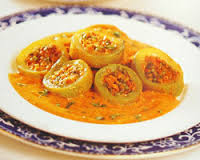
stuffed lauki

And after a long hiatus, I have a guest post today – am so excited! My dear, dear friend Priya, who’s stood by me through thick and thin and who I don’t ever have to turn around and see to know she’s batting in my corner, has contributed this story of how we met – 33 years ago on our first day in college.

I must tell you a little bit about Priya’s tiffin dabba here – a dabba that reached college along with her at 10.00 a.m. (Nizami timings for Nizam College those days!) and would go back into her bag at 10.15, suitably lightened – by Shreesha and me! I still miss your dabba, Priya!

Over to Priya:

I met Anu on the first day of College 33 years ago. A tiny waif of a girl with the proverbial 18 inch waist and glasses covering half her face, and I was to realise soon enough that her size was more than compensated for by a huge delightful personality! She was lost to the world, busy reading a book of poetry by Robert Frost and that made me stop right in front of her. Everything about her seemed perfect to me and I decided I had to be her friend. It is now 33 years later and I have found no reason to change my mind and I stand firmly by the wise decision I made that day!!

It was my good fortune that she collected oddballs and decided I would do too!

And speaking of friends lost, it was during one of those years, I had invited a group of college friends home for a meal. It was the middle of summer and since, at that time, I lived in an unknown area of the cantonment – army accommodation, known as Allenby Lines in Bolarum; very elaborate instructions to reach had been given to all my friends along with bus numbers and a map. Hyderabad summers being what they are – every one trooped in- hot and sweaty, but there was no sign of Anu. Finally a call made my fears come true. Sure enough, Anu had boarded a wrong bus and landed up at least a few kilometers away. It was a time of no cell phones, no cars either and a call from a PCO made one panic.

Luckily we were young and had no bones creaking yet, so I trekked in 40 degrees plus temperatures to rescue her. I drank only water for the rest of the day. The heat and the adventure had no effect on Anu and after all her troubles, cheerfully tucked into the various vegetarian dishes cooked, which was a rarity in our Hyderabadi home where the menu is usually the biryani, kabab and chicken variety! The dulmas were on the menu that day and are today! The picture is from the internet as I will only cook lauki when Anu is visiting!

Here’s to many more lunches Anu and dinners !!

Lauki ke Dulme (Stuffed Lauki)

  • 1 long narrow soft lauki cut in 2 inch pieces and scooped out to form cups
  • Moong dal soaked 1 cup or fresh paneer if you like!
  • Onion paste of 4 medium onions
  • Tomato puree of 3-4 tomatoes
  • Ginger grated – a teaspoon
  • Ginger garlic paste – 1 teaspoon
  • Green chilies – sliced fine
  • Green coriander – chopped
  • Mixed whole spices – a few cloves, cardamom, a stick of cinnamon, pepper corns, jeera seeds
  • Garam masala- ground
  • Red chillies powder – to taste
  • Salt –to taste
  • Turmeric powder- a pinch
  • Oil – a couple of tablespoons

Using a largish flat bottomed pan, heat the oil.

Add mixed spices to the oil, when the jeera starts spluttering add the onion paste and cook till done.

Add the ginger garlic paste and fry for a few minutes more.

Add the tomatoes,salt, the other spices and lower the heat and allow the gravy to cook.

In a separate plate, mix the dal with salt, red chillies, garam masala, some green chillies, green dhania, grated ginger and mix well.

Stuff this mixture into the lauki cups.

Check if the gravy is well cooked, then add the cups of lauki, keeping them straight.

Add water and cook covered on low heat.

Add more water if and when needed.

Check to see if the dal and lauki is cooked, it should be done in about 20 minutes.

The vegetable should be cooked but firm and the same with the dal.

Carefully lift each lauki cup onto a flat dish and then pour the gravy on the sides.

Sprinkle the green dhania and green chillies on top and serve.

And long live poetry, Priya!