Vadiyaalu paalu koora: Of the uses of cold cream…

“Dochi, do you know that is very expensive? It costs ten rupees a bottle!” admonishes the great-aunt.

Ten rupees???!” Her eyes grow saucer-like trying to grasp this enormous figure! And she gets back to her task with added vim. All of two years old, the little girl is engaged in polishing the floor of her grandmother’s house – dipping her chubby fingers into a jar of – cold cream!

The lesson my aunt is trying to teach is about valuing things and waste – obviously! The lessons that are learnt by little kids sometimes make you sit back on your feet – Dochi takes it to mean that the cold cream is so valuable that she had better do a really, really good job of trying to make the floor shine!

A few years later, the same little girl, now slightly older, has acquired a brother, Arjun, whose antics challenge the world around him – all with the sweetest, butter-wouldn’t-melt-in-his-mouth beam on his face that made it impossible for anyone to be cross with him for long (come to think of it, a little over two decades later he hasn’t changed much!) And so one day, at the lunch table, he’s at his favourite pastime – pushing the food around his plate. His patient grandmother is cajoling him to eat and he tells her, “But, ammamma, see the eagles are landing!” pointing to one lone fly buzzing around! The word in Telugu for fly (the insect variety that is, not the action it performs) is “eega”. The plural would be “eegalu”. Our pal, caught in a hard place between his Telugu genes, the Tamil-speaking Madrasi setting and the primarily English-speaking home, tries to make sense of his world by Anglicising whatever words he knows of in Telugu and Tamil! Thus paraphrasing Jack Higgins without ever having heard of him (he was only three years old!).

Another cousin, angry with his mother about some withheld privilege, chases her around the table, yelling, “I’m going to kill you, I’m going to kill you!” The shocked mother scrambles around the table, evading the boy’s hands, wondering where she’s gone wrong and pleading with him to please not use such language. The seven-year old pauses, “Oh, I meant only the Tamil “kill” ma. not English “kill”!” The word “killu” in Tamil means to pinch! The mother devoutly delivers up a prayer of thanks!

For most of us living in countries/cities not native to us, our vocabularies have been hugely enriched by the things our children say and do…

Unlike this “pure” Andhra dish which stays completely true to its origins…


VADIYAALU PAALU KOORA/Milk based gravy with ashgourd fries (for 2 servings)

[Recipe courtesy my dear friend Shreesha’s mother]


  • 1 small katori (about the volume of 1/3 cup) – boodide gummadikaaya vadiyaalu/ashgourd fries/petha vadis – these are made by soaking urad dal overnight, draining and grinding along with green chili paste, salt and grated ashgourd (wintermelon) from which the water has been drained. This water is used for grinding. The paste is then made into little flattish discs and sundried for 2-3 days till crisp. These are stored for the whole year and fried as needed. I microwave them sometimes – when I have guilt pangs, basically!  They also make a great substitute for vegetables in a gravy or you could add them to a curry or a gravy when you have unexpected guests and need to “multiply” food!
  • Hot milk – 1 cup
  • Chopped onion – 1 medium
  • Green chilies – chopped – 1 or 2
  • Curry leaves – chopped – 2 sprigs
  • Salt
  • Koora podi – 1/2 tsp – optional. See this link for the powder
  • Oil – 1 tsp
  • Ghee – 1/2 tsp
  • Mustard seeds – 1/4 tsp
  • Urad dal – 1/2 tsp
  • Jeera – 1/4 tsp
  • Asafoetida – 1 pinch


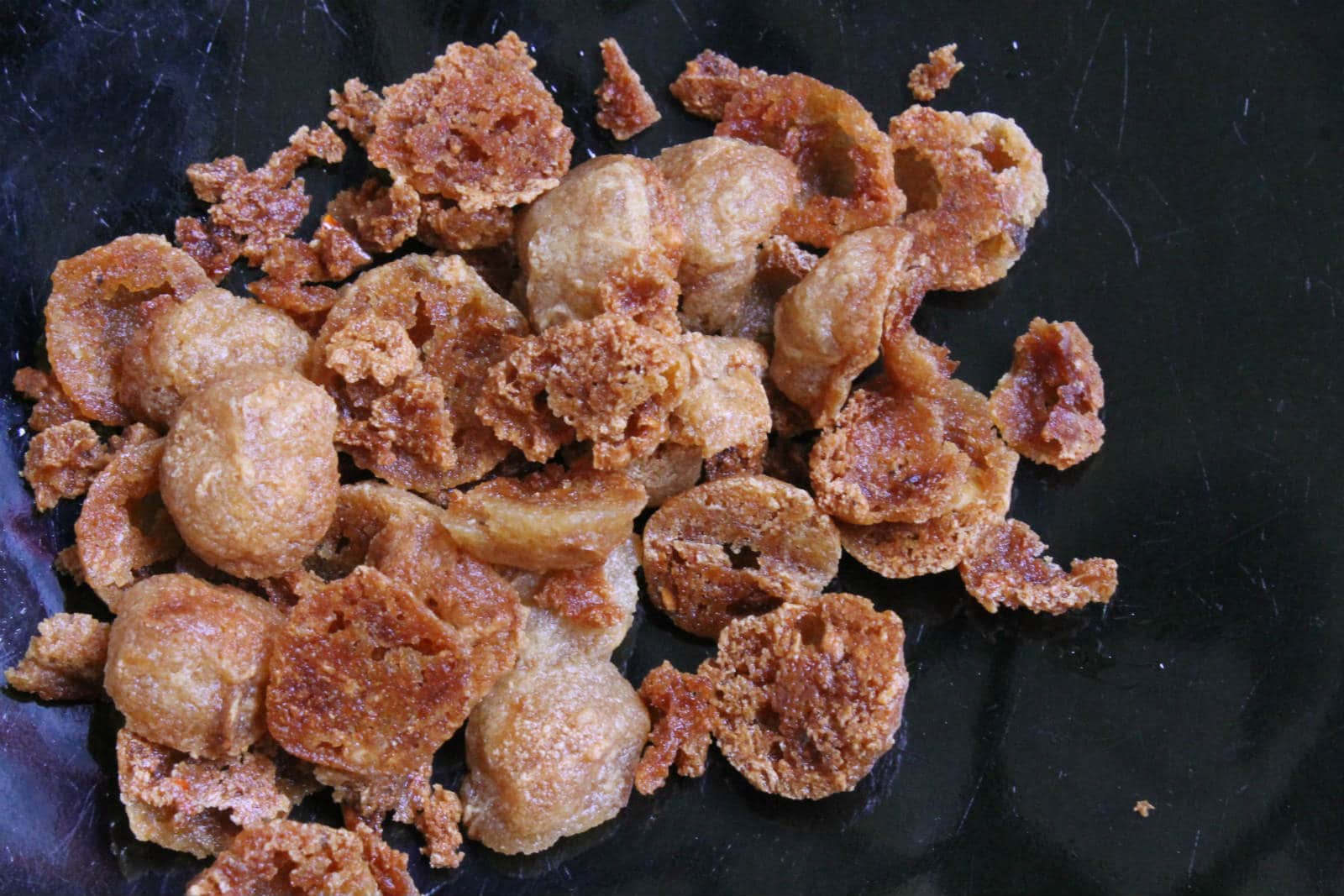
Heat the oil in a pan and shallow fry the vadiyaaly till they turn a deep golden brown – see pic. This will take about two minutes. Set aside. You could deep fry the vadiyalu and drain.

In the same pan, add the ghee. Heat and splutter the mustard seeds in it. Add the urad dal and jeera and roast till the dal is golden. Add the onions, curry leaves and green chilies and saute for 3-4 minutes till the onions turn golden brown.

Add the hot milk – if the milk is cold, it will curdle.

Add the koora podi (curry powder) and salt. Remember the vadiyalu already have salt so add just enough for the onions and milk. Add the fried vadiyalu and cook on a very low flame for about 5 minutes. The milk may curdle but it will taste just as good!


Yummy with rice or rotis – this has a distinctively smokey flavour which is quite delicious.
Gongura thokku: A tale of daydreaming and random musings on shiny purple shirts!

The bus rolls to a halt and a young girl, lost in a daydream, steps off. Unfortunately the bus hasn’t quite stopped yet and she falls flat on her face on the tarred road. The bus driver and conductor are very concerned but she picks herself up, more embarrassed than hurt, dusts herself off and walks off home. It isn’t till she reaches home and cleans herself up that she realises that she’s hurt herself quite badly – the knees are badly skinned (I still carry the scars). I don’t mind the pain but the brand new pair of Levi’s I am wearing (swanking around in, actually!) are quite ruined – and that, as any kid who grew up in those decades will tell you – was quite a tragedy!

Ours was the last generation, I think, who had new clothes bought for precisely two or – if you were rich – three occasions in a year – Deepavali, one’s birthday and sometimes Ugadi. You wore these through the year and passed them on to smaller cousins as you outgrew them and your wardrobe (basically one half of a cement shelf in the parents’ room!) got replenished by hand-me-downs from older cousins. New clothes were not precisely bought either – readymades were rare and expensive. It was far cheaper to buy material and get your stuff tailored by the local tailor – who catered to the entire family – dad, mom, boys, girls, old people – the works. The “master” was always instructed to stitch clothes that would last – for a couple of years at least. With the result, new clothes were inevitably baggy, literally” hanging loose” everywhere and reaching at least five or six inches longer than your current measurements!

In all the photographs of our childhood, my brothers are dressed in shorts which hang at least four inches below their knees and would qualify for bermudas today! No, no, they were not forerunners of fashion, and being no more than four years old, just victims of the age of “saving” and “making things last” almost forever!

Most large families bought taans (a full roll) of material as it was cheaper and everyone would have something made of the same material! I remember a neighbour, a gentleman with nine children, whose kids turned out one Deepavali morning clad in shiny bright purple – ranging from long skirts (paavadais) and blouses and frocks for the girls, shirts for all the boys and finally the mom comes out – in a purple blouse! As clothes got handed down from oldest to youngest, the littlest fellow must have spent the better part of his life clad in bright purple – bet he won’t even eat eggplant now!

The loss of my new pair of fashionable brown corduroy Levi’s ( a brand not available in India till well over a decade later), sent by a cousin all the way from America, was quite shattering! The fact that I almost shattered my kneecaps too didn’t seem to matter so much somehow!

So there I am, having administered first aid to myself and trying to not think about the pain, when the doorbell rings. I groan – it’s not easy to walk and there’s no one else at home. Plus it hasn’t been so easy to find something to wear that doesn’t hurt the wound so I am in a nightdress – something that I hate wearing in the daytime! Grumbling a bit, I hobble to the door and open it. A young man in a khakhi uniform is standing at the door. I don’t recognise him, though he looks vaguely familiar.

“I am so sorry, Madam (huh, I’m all of seventeen years old!), but I came to check if you were hurt badly. I am the driver of the bus you got down from today and I am so sorry blah, blah… ” he says. My jaw drops. For one, I am pretty sure that I wouldn’t have fallen if I hadn’t been daydreaming and for another, the guy has actually taken the trouble to find out where I live and come after his shift to apologise – for something that is not even his fault!

Does my country have a heart or what???!!!

Just like this dish which lifts the hearts of Telugus world over… you can take a Telugu out of India, but can you take gongura pacchadi out of his bloodstream?!!


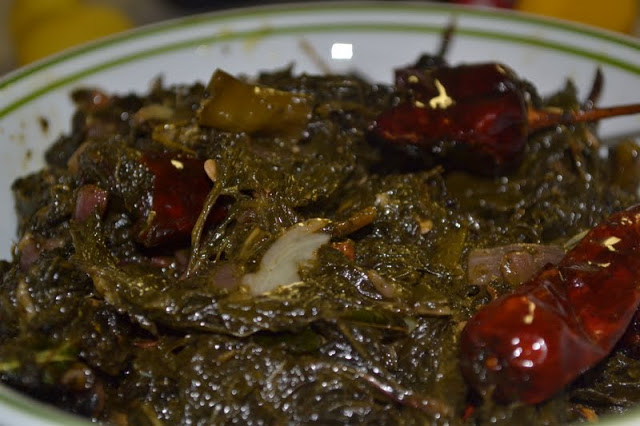
GONGURA  THOKKU  OR  GONGURA  DIP

(Recipe courtesy my aunt Malathi Mohan)


  • Gongura …… 1 bundle
  • Black gram dal ….. 3 tbsp
  • Dhania seeds …..1 tbsp
  • Jeera ….. 2tsp
  • Hing powder  …… 1 tsp or more as per taste.( Hing cake is more flavoursome)
  • Jaggery  …… 1 tbsp
  • Red chillies ……8  nos
  • Methi seeds ….. 1 tsp
  • Salt …. 2tsp (to taste}
  • Gingelly / sesame oil …. 4 to 5 tbsp
  • Garlic … 1 whole, peeled
  • Onion …1 big, cut into big chunks


Pinch the leaves from the stem, wash well and air dry on a kitchen towel. Chop roughly to small pieces for ease of grinding, later.

Roast the dry ingredients and grind to powder, then cool. Grind roughly for thokku and finely for the dip.

Heat 1 tbsp. oil , fry the onion and lightly roast the chopped leaves. They will lose the green colour with heat, so let some remain green. Allow to cool.

Grind the leaves with the powder, adding salt to taste. Roughly for thokku and soft for the dip.

Heat the remaining oil, fry the garlic slices, sprinkling two pinches of salt, add the ground mix, and  jaggery and cook the mix till it leaves the sides of the pan in one single mass.

Mix the thokku with hot rice and ghee. Serve with plain raw onion.


The dip can be used with pita chips or any other innovation that Madan Valluri is adept at. Actually, it was Madan who made me realise that this can be a dip too if ground well. Thanks, Madan. This beats all other western dips in my opinion!!

Roasted masala green peas: Of food and home-grown philosophers…

For the longest time, I thought there were some foods that could only be bought in shops – it was quite unthinkable to make them at home. Hmmm… come to think of it, for a lot of people I know, that goes for pretty much anything except Maggi noodles – which can be made at home – in two minutes!

The recent ban on Maggi has meant that for all these poor souls, there is simply nothing at all which can be cooked at home… which brings us to the thought… real estate developers should really cash in on this trend and stop wasting precious FSI space building kitchens and stove tops and ceramic tiles and the rest of the hoohaa that you use to sell kitchens – and apartments with! You see, Mr-Real-Estate-Developer-who-makes-fat-profits, these guys are just not interested! Use the space to give them a karaoke bar instead, or maybe just a plain ol’ bar! Watch your profits go higher than that sixteen-storeyed tower you’re building – and pay me royalty for the idea…

But back to normal people who need to make their three square meals a day – ever wondered why they call them square meals when almost all plates you see (except the ones in fancy restaurants which make you bankrupt as you pay for one meal!) are round in shape? We need kitchens and these function – more or less through the year.

Candy (particularly those egg-shaped pastel coloured all-day suckers!) and pootharekus (Andhra rice paper sweet) apart, which I have never seen anyone make at home, I pretty much managed to get past this barrier of making fancy food at home. The food philosophy (I learnt this fancy phrase watching, actually devouring – Masterchef Australia, by the way!) that most of us grew up with was – if anything yummy can be bought “outside”, it is always yummier – and “healthier” (key phrase!) made at home! Even though the evidence piled up on the other side (read the many adventures involving my mother’s living out this philosophy!) the idea was so ingrained in us that we were quite brainwashed!

The one exception that I came across was my friend Viraja, who, despite being a superb cook, always advised me, “Don’t spoil the family  by giving them fancy food at home. If they want it, sell restaurant food for all you’re worth – it’ll save you a lot of trouble. After all, why make it at home when you can buy it outside??”

Today, I realised there are still some fences that I need to jump – in my head! Was munching my way through a packet of virulently green crunchy masala peas when I realised that this is one of those things that we never make at home… despite it being one of my favourites  – the more virulently green, the better, as far as I’m concerned! They used to be sold by bandiwallahs (pushcart vendors) outside schools – for ten paise a pop – a pop being a small cylindrical aluminium container which measured out about half a cup of the delicious crispy toasty, very spicy (fire out of the ears, wipe your forehead, keep a tissue handy kind of fierce spiciness!) little spheres.

And so, here’s a recipe:


ROASTED MASALA GREEN PEAS


  • Frozen green peas – 500 gm
  • Oil – 2 tbsp
  • Salt – 2 tsp
  • Chili powder – 1 tsp
  • Asafoetida – 1/4 tsp
  • Cumin powder – 1 tsp
  • Chaat masala – 1/2 tsp – optional
  • Juice of 2 limes
  • Sugar – 1 tsp


Spread the peas out on a towel to dry for about an hour. Pat dry.

Mix all the other ingredients in and spread them on a baking tray lined with paper. They should be in a single layer.

Bake at 350C for about 30-35 minutes, shaking the tray every ten minutes till crunchy and dry (the peas, not the tray!)


Let cool completely and store in a tin. Just eat them plain or serve dressed with chopped onions and tomatoes and a little lime juice sprinkled over the top.

Or, if you own one of those new condos which you’ve bought from the real estate builder whom I’ve been advising, just buy them in a packet and open them!

Capsicum and spring onion curry with chickpea flour: Of old men and their dhotis!

“The old man is tying a dhoti.”

Huh?

The old man is tying a dhoti... ajooba dhotar nesthaat, ajooba dhotar nesthaath, ajooba dhotar nesthaathajoo… zzzzz…” and the voice fades away into the gentle breathing of childhood sleep….

“Wake up, Tej, time to get ready for the exam,” and the poor kid is awakened – not rudely though…

….mumbling, “Ajooba dhotar nesthaath… ajooba…” all the while he is getting ready for the Marathi exam at his school in Mumbai.

His dad (born and bred in Madras, barely able to string two words of Hindi together!), also helps matters along by prompting  helpfully… “Ajooba… ajoobaaa… ” and applauding with joy every time the kid finishes the sentence – “…Dhotar nesthaath“!! Yay!

And thus, murmuring this formula for success, they arrive at school… in time for the exam.

Proud dad wishes kid all the best, confident kid (he knows all about ajoobas and dhotars, remember?!) waves jauntily and positively swaggers into the exam hall , finds his place and sits down. The question paper is handed out. Kid peers at it, sure that he’ll ace the exam…. wait… whaaaat?? No mention of old men and their dhoti-wearing skills???! Phussssss… goes the confidence… he struggles through the exam, trailing home sadly at the end of the day – it so not fair – I know Marathi and that lesson on old men and dhotis – how can they not give the question in the exam?!

The dad, being a sympathetic sort – remember our pal with the towel around the long hair  in the lift? Also the gentleman with the BMW keys? Same dad – he understands the son’s predicament very well – having been in the same predicament in a Sanskrit exam decades ago! Let me digress a bit and go back some thirty five years into another exam hall – in Madras this time. The subject is slightly different – Sanskrit – but the principles of old men and dhotis stay unchanged.

In those days, one could write the Sanskrit exam in English – basically as long as you understood the question, it was okay to answer any which way! Having been assured by a good friend – the nerd of the class (it is always a good idea to keep in with the nerds!) that he would help him with the exam, our pal has gone completely unprepared – to find Mr Bill Gates-to-be’s pen flying across the paper – in Sanskrit, not English! We are defeated! We do the next best thing – we become a very sympathetic dad – vowing never to let son down in any language paper – hence the dhoti-tying session!

The son trails home disconsolately. The dad reassures him : “Never mind about the exam. The important thing is that you learnt Marathi!”

And thus, there is a father-son duo floating around in Bombay looking for an occasion to practise their Marathi – when they can remark fluently and like native speakers of the language, The old man is tying a dhoti!  Unfortunately, till the time of this going to the press, the occasion has not arisen…

One doesn’t need an occasion, though, to make this unusual Marathi dish…


CAPSICUM AND SPRING ONIONS CURRY WITH CHICKPEA FLOUR


  • Capsicums/bell peppers – 2 large – slice into thin slivers – about 1 cm long by 3 mm thick
  • Spring onions – 1 bunch – about 2 cupfuls. Slice the white onion part into rings and the green stems into 1 cm long pieces.
  • Chickpea flour/besan – 1 cup
  • Chili powder – 1 tsp
  • Dhania/coriander pwd – 1.5 tsp
  • Jeera/cumin pwd – 1 tsp
  • Turmeric – 1/4 tsp
  • Asafoetida – 1/8 tsp
  • Sugar – 1 tsp
  • Salt
  • Oil – 2 tbsp + 1 tsp
  • Garlic – 1 or 2 flakes – crushed (optional)
  • Ginger – 1/2 tsp – minced
  • Green chili – 1 minced
  • Juice of 1 lime
  • Chopped fresh coriander to garnish


Mix the powders and the flour together. adding salt. Roast in a dry pan for 5-6 minutes till it becomes a golden yellow and smells nutty. Heat the 2 tbsp of oil and pour it into the besan. It will froth a bit – not to worry – just watch your fingers!

Transfer to another plate to cool. If you leave it in the same pan, it will continue to brown. When cool, mix well with your fingers to break up lumps.

Saute the capsicum pieces on high heat with a few drops of oil for 3 – 4 minutes. Set aside.

In the same pan, add 1 tsp oil and saute the ginger, garlic and green chili. Add the whites of the spring onions and stir fry on high heat for 3-4 minutes. Add the greens and continue to saute for a minute more. Add the besan mixture and the capsicums and the sugar. Stir well, cover and cook for about 5-6 minutes till vegetables are tender.

Remove from heat. squeeze over lime and garnish with coriander…


Serve with rice or rotis or pooris… to the old man waiting to tie his dhoti!

Herby wholemeal bread: Of hospitals and men…

“You’ve got my will safely filed away? How about the file with all the passwords in it? You know where it is, right?”

He turns to his two little daughters, “Hold my hand, baby… ” and the two little ones each promptly clutches one of the father’s hands in hers…

He takes a deep breath, closes his eyes and braces himself… for the ordeal to come…

A scene from a Hindi movie deathbed… you think?

Nothing so mundane! It’s just hubby getting ready for a wee blood test!

In the early days of our marriage, I used to think he was funning – when he started shivering hours before he was due to see a doctor and god forbid, if the doc prescribed any invasive tests, well, let me just say that I’d rather do an apprenticeship as a toreador than drag this very reluctant, very squeamish, very scared person to the lab! But the shivering continued… after the children were born, he was much happier – now instead of one unsympathetically giggling wife, he had two very concerned daughters to help him along!

Across the ancient city of Madras are spread many analysts in many laboratories whose lives have been brightened considerably by my husband’s antics in the lab! The visit typically goes like this:

Scene: A drab, white-tiled laboratory room with a white-coat clad analyst, looking very sleepy and bored with his job…

Enter: One middle-aged man, slinking in furtively, casting quick glances all around, in the hope that if no one notices him, he can go back and tell the doctor that the lab analyst was on leave and therefore the test could not be done! Hopefully the doc will buy the story and just give him some pills!

But, unluckily for him, most analysts have been trained for just such situations – to find patients lurking in the woodwork… and they pounce on him – politely of course, helping him off with his shirt or whatever else needs to be helped off!

The man starts shivering. Please don’t take more blood than you need to, starts the plea.

Analyst: No, sir, we are going to take just 2 ml.

Middle Aged Man  hereinafter called the MAM (in shock!): What??! How can I walk out after that? I will faint! I have a family to take care of, you know!

Analyst (giggling): No, Sir, don’t worry, we will be very careful!

MAM (looking piteously at the two little daughters… he know it is useless to appeal to giggling wife for sympathy): Please hold Appa’s hands… (makes sobbing sounds)… this uncle is going to take Appa’s blood!

Children clutch their father’s hands… in the days before they grow out of it!

The needle is now pulled out gently.

MAM (sits up straighter and changes tone – more confident): You have some kind of part time job in the police department, do you?

Analyst pauses in the middle of doing things to the test tube and answers seriously: No, Sir, why?

MAM: Because if you don’t, you should apply for one. The kind of job where they torture people to extract confessions from them?! You’d be very good at it!!

The analyst, who’s been wearing a worried frown on his brow till then, chuckles loudly and smiles to himself in anticipation – what a story he will have to tell at the lunch table today!

Exeunt MAM with two small children, trailed by unsympathetic wife, slyly winking at the analyst as she leaves!

And that is the story of why labs all over Madras love my husband!

And what else can I serve after these ordeals but comfort food? In the form of this delicious…


HERBY WHOLEWHEAT LOAF


  • Wholewheat flour (atta) – 2.5 cups
  • Plain flour (maida) – 1 cup
  • Yeast – 1 tsp
  • Milk powder – 2 tbsp
  • Sugar – 2 tbsp
  • Salt – 1 tsp
  • Rosemary, oregano, dill, tarragon, basil – 1/2 ts each – dried herbs
  • 1 egg – optional
  • Butter – 2 tbsp
  • Warm water – about 1.5 cups (I usually freeze the whey left over from hung curd or the water strained out of making paneer (cottage cheese) in cups. I store these lumps in a ziplock bag and warm them up and use that to knead all my doughs)


Prove the yeast by sprinkling over a little warm water and letting it rest for ten minutes. It should turn frothy.

Add all the other ingredients and mix. Take out of bowl and knead on a counter top, sprinkling a little flour to stop it sticking, for a good ten minutes at least. The dough should, by now, be elastic and spring back when you poke a finger in it.

Cover and rest till doubled in size – about 45 minutes.

Knock back, shape and place in a greased loaf tim or a pot if you want a pot loaf.

Bake at 180C for 25 minutes and lower the heat to 160C. Bake a further 10-15 minutes till the loaf feels hollow when you tap the bottom of the tin.


Cool completely before slicing. Makes an awesome sandwich bread too.

No need to join the police department to make this!